AI-Driven Drug Discovery Gains Ground in Germany
Biotech and AI are injecting fresh momentum into life sciences. Germany is becoming a hub for AI-driven drug discovery, mRNA and pathology models that attract international firms.
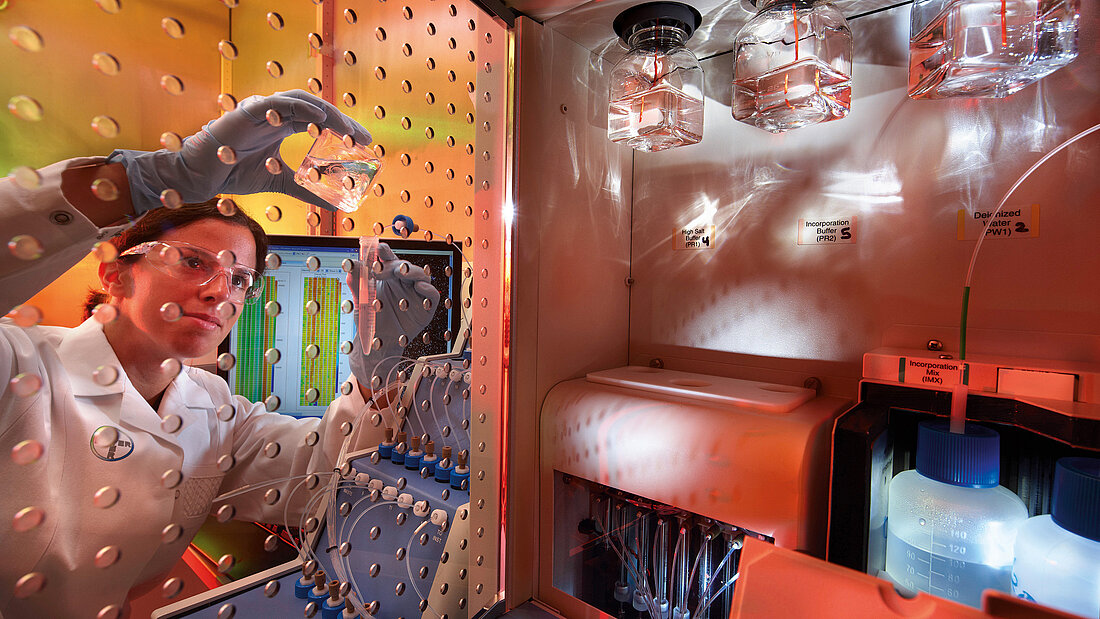
In January 2026, a start-up called Aignostics introduced Atlas 2, a new state-of-the-art pathology foundation model: it analyses digital tissue images, revealing subtle cellular patterns in tumors that can accelerate the development of more precise cancer therapies. With Atlas 2, the Berlin-based newcomer has positioned itself as one of the most compelling examples of the emerging AI4Bio trend – and it chose Germany as its launchpad.
Rooted in Berlin’s vibrant life science and tech ecosystem and built in collaboration with leading institutions such as the hospital Charité in Berlin, the LMU university Munich and the US-based Mayo Clinic, Aignostics showcases what becomes possible when world-class medical data, strong academic networks, and a growing AI talent pool come together.
This unique combination makes Germany a natural hub for AI-driven biomedical innovation. The country stands on the cusp of a new biotech boom that’s propelled by advances in AI – a transformation that is reshaping not only where research happens, but how it is done. For internationally active companies looking for a foothold in Europe, this opens up substantial business opportunities – not least because they can draw on Germany's formidable strengths as one of the world's premier research and development locations.
“Germany offers pharmaceutical and biotech companies a highly attractive environment,” says Agnieszka Rzepka of the Healthcare Export Initiative at Germany Trade & Invest (GTAI). “As Europe's largest healthcare market, the German healthcare industry contributes around 12 per cent to total gross value added.”
Read this article to find out:
1. Why Germany is becoming a hub for AI-driven drug discovery.
2. Which institutions and partners are shaping AI-based biotech research.
3. How Germany's ecosystem and EU funding give companies an edge.
AI for good
Beyond Aignostics, a strong cohort of major German and international companies remains firmly committed to AI-driven biotech development in Germany. And the list is growing: Bayer is collaborating with AI company Recursion Pharmaceuticals; Boehringer Ingelheim has partnered with Google Quantum AI; and Roche has joined forces with Munich-based AI company Temedica. High-growth start-ups are also reshaping the landscape. Munich-based Tubulis, for example, announced a partnership in 2025 with Mindpeak, a leading AI company for pathology automation.
AI partnerships offer tangible advantages for the pharmaceutical industry: they broaden research programs, accelerate laboratory workflows, and improve the odds of success in fields such as oncology, immunology and neurology. French pharmaceutical company Sanofi is the case in point: “We have integrated AI into numerous areas of our research and
development,” says Thomas Klabunde, Global Head of Translational Disease Modelling at Sanofi Germany.
Accelerating drug discovery with AI
The AI4Bio trend is making inroads across many areas of Sanofi's operations. Machine learning, for instance, can identify previously hidden patterns in so-called multi-omics data – that is, data integrating multiple levels of biological information, beginning with genomics, to enable a comprehensive analysis of a person's health status. By harnessing vast quantities of data, the company gains deeper insights into complex biological systems and disease mechanisms.
Sanofi deploys AI to shorten research timelines through improved predictive modelling and to automate time-consuming tasks. Its Frankfurt branch plays a pivotal role in this effort: the site is a key node in the company's European research network, housing centers of excellence for AI-based drug design and multi-specific protein engineering.
A high-performance ecosystem for AI-based biotech
In Germany companies benefit from an outstanding ecosystem. Renowned institutions such as Goethe University Frankfurt, the Max Planck Institute for Biological Intelligence, and the Fraunhofer Institute for Translational Medicine and Pharmacology (ITMP) form an innovation network concentrated in life sciences clusters in the Rhine-Main region, Berlin, and Munich. “The interdisciplinary networking of academic and industrial expertise creates excellent conditions in this country for using AI in a targeted manner to accelerate research processes and translate scientific innovations into therapeutic solutions even more efficiently,” says Klabunde.
A further powerful stimulus for Germany's AI4Bio scene comes from Brussels. Numerous European Union (EU) funding programs – among them Horizon Europe, the European Innovation Council, EU4Health, and the planned “Important Project of Common European Interest” – are backing research projects, start-ups and the development of Europe-wide production capacities. The new European Health Data Space, meanwhile, will make a continent-wide trove of electronic patient health data available for research purposes.
“Anyone looking to invest in European biotechnology cannot ignore Germany.”

Making the difference
With the growing number of AI-driven biotech projects, Germany is consolidating its role as central Europe's hub for medical innovation. The country boasts an exceptional concentration of life sciences players, with more than 700 biotech companies and more than 50,000 skilled professionals.
The market that is shaping up offers ideal conditions for research and clinical development, manufacturing and global commercialization. “Anyone looking to invest in European biotechnology cannot ignore Germany,” says Rzepka. “An ecosystem of substantial funding, modern infrastructure, and strong intellectual property protection creates a comprehensive package here that is unmatched in Europe.”
FDI Perspective
Europe's Biotech Strategy
By Agnieszka Rzepka, GTAI Health Industry Export Initiative
The new European Biotech and Biomanufacturing Initiative (EBBI) sends an unambiguous message: Europe is serious about strengthening its position as a global biotech hub. The initiative aims to mobilize EUR 10 billion in investments by 2027 – the strongest European impetus to date for biotechnological innovation and industrial scaling. Its goal is to streamline the path from research to finished product through accelerated approval processes and targeted support for key technologies such as AI. This provides planning certainty and makes Europe a magnet for private capital.
For internationally active companies, this opens up strategic opportunities for market entry. Any company establishing a subsidiary in Germany is treated as a European player and thereby gains access to EU funding sources such as Horizon Europe, the European Innovation Council, or future large-scale projects like the planned IPCEI Health (Important Projects of Common European Interest). Combined with Germany's leading research institutions, strong life sciences clusters and industrial production capacities, an investment here becomes a gateway to the entire European biotech market.
Want to explore your business opportunities in Germany’s AI4Bio landscape?
Agnieszka Rzepka
GTAI Health Industry Export Initiative