Germany's Battery Recycling Market Scales Up
Spent EV batteries and strong demand for critical raw materials are fueling new chemical recycling in Europe. Germany is emerging as a key hub for battery material reclamation.
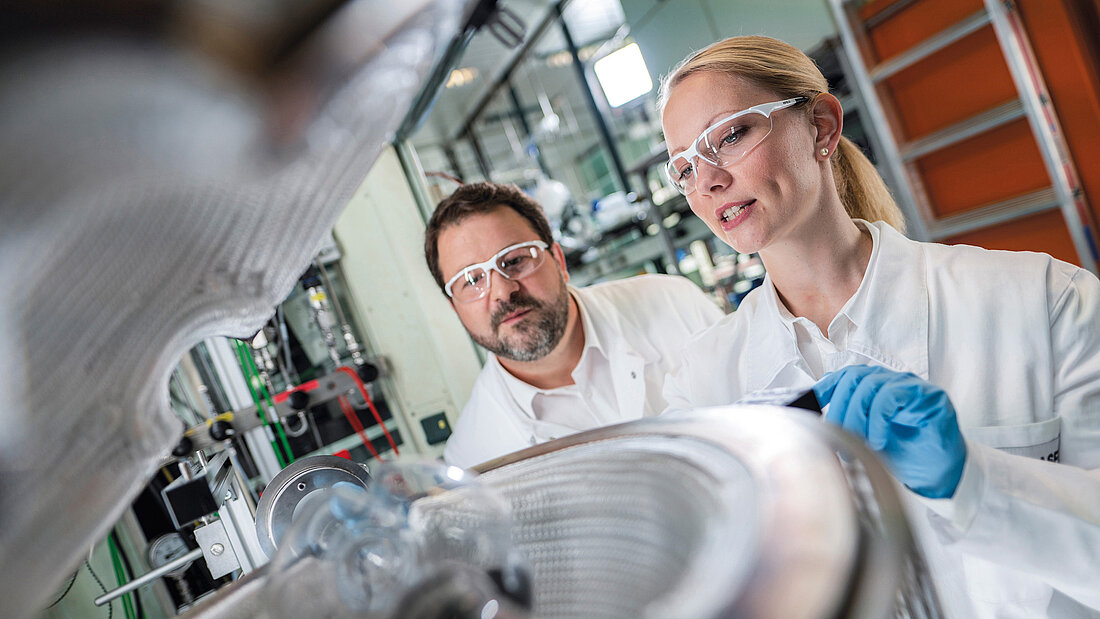
The small southwestern German town of Kirchardt is where batteries go to retire. It is here that the Finnish company Fortum operates a facility dedicated to discharging and dismantling them. What remains when the process is complete is a substance known as “black mass” – a fine, dark powder composed primarily of lithium, nickel, and cobalt. Hydrometallurgical processes are then deployed to separate and refine these metals. Business is booming: Fortum is already investing in a second German site, this time in Artern, in the east of the country.
Fortum is not alone in its optimism. Germany has established itself as one of Europe's most attractive locations for battery recycling, benefiting from the volume of spent batteries arriving on the market, not least from the growing number of retired electric vehicle (EV) batteries. The key is the dense network of partnerships between companies and research institutions, which are advancing hydrometallurgical recycling as a highly efficient method and scaling it from pilot projects to full industrial operations.
The depth of Germany’s expertise in this field is reflected in its patent activity. Three German companies – BASF, Robert Bosch, and Duesenfeld – rank among the most prolific European applicants in the battery circular economy.
“More and more international companies are discovering Germany as a location to scale up recycling processes to an industrial level in partnership with industry and research players,” says Germany Trade & Invest battery recycling expert Nicolas Brahami.
Read this article to find out:
1. How innovative battery recycling processes work.
2. Which German regions offer locational advantages.
3. How international players can use Germany’s infrastructure for pilot projects.
Chemistry in Clusters
For international companies seeking to enter the German battery recycling market or expand existing operations, regional clusters offer the most compelling entry points. Several prominent players are concentrated in western Germany, where institutions such as the Fraunhofer Research Institution for Battery Cell Production (FFB), Münster Electrochemical Energy Technology (MEET) and RWTH Aachen University are developing and scaling new recycling processes. These efforts have produced ventures such as Cylib – a
spin-off from RWTH that is building an industrial facility with a capacity of up to 60,000 tons of used batteries. That’s the equivalent to 140,000 electric vehicle batteries.
“Germany's chemical parks offer unique advantages by providing ready-to-use infrastructure and industrial integration,” notes Brahami. “That can significantly accelerate project development.”
“Germany combines strong research, pilot infrastructure and close cooperation with industry. It’s an excellent basis for bringing new recycling technologies to market.”

From Pilot to Scale-Up
A robust ecosystem is also taking shape in eastern Germany, offering international recycling players fertile ground for collaboration. The CeChemNet chemical cluster, which brings together six chemical parks, is actively fostering investment in battery recycling capacity. Research institutions and industrial partners are collaborating on scalable recycling processes, among them the joint venture between The Battery Lifecycle Company, EAS Batteries, Freiberg University of Mining and Technology and the Fraunhofer Institute for Ceramic Technologies and Systems (IKTS).
Fraunhofer IKTS operates several modular hydrometallurgical pilot plants. For Sandra Pavón of Fraunhofer IKTS, the pilot setup in Germany is a textbook illustration of the country’s strength as a recycling location.
“Germany combines strong research, pilot infrastructure and close cooperation with industry,” Pavón says. “It’s an excellent basis for bringing new recycling technologies to market.”
Turning chemical waste into value
Volume of the European battery recycling market
| year | volume |
|---|---|
| 2025 | USD 8.74 billion |
| 2030 | USD 15.22 billion |
Source: MarketsandMarkets
Want to explore battery recycling opportunities in Germany?

Nicolas Brahami
GTAI’s battery industry expert