Germany’s Data Center Campus Boom
Campus projects in Germany bundle power, cooling and heat reuse for multiple data centers. Construction and engineering firms and energy storage providers can benefit.
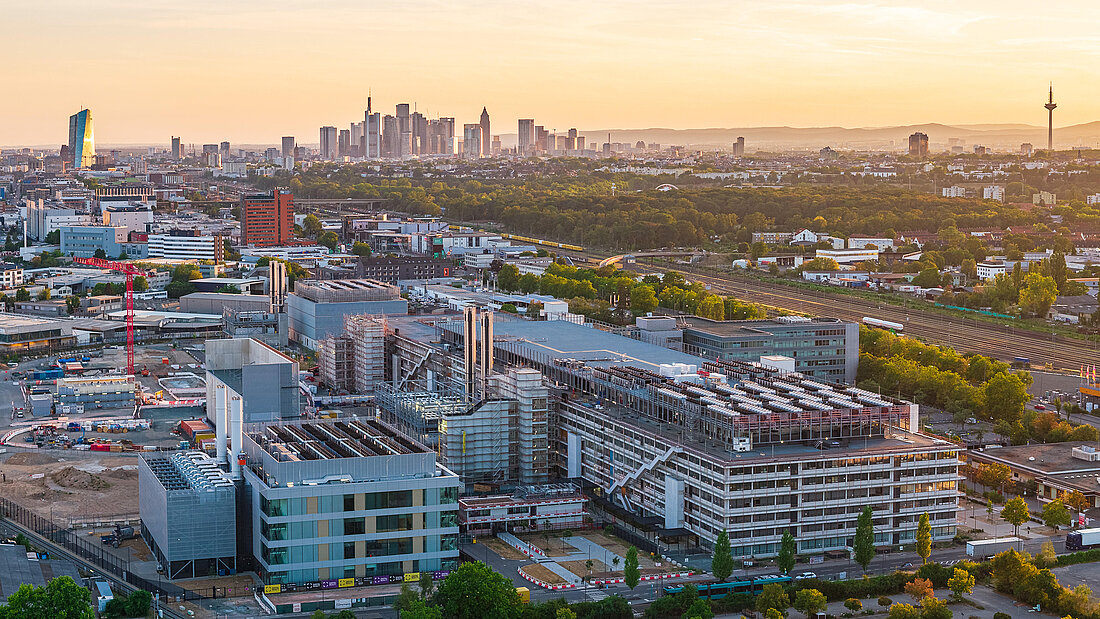
For nearly a decade, a sprawling industrial site – the former headquarters of a mail-order company – lay dormant in Frankfurt am Main. But it’s currently being completely transformed by US data center giant Digital Realty into the Digital Park Fechenheim: a huge data center campus designed to host a large number of facilities in a single location.
Construction commenced in 2022, and upon completion of the full build-out in 2030, the campus will feature 11 interconnected data centers spanning 90,000 square meters – roughly the size of 12 soccer fields.
The key advantage of such large-scale sites is that power supply, cooling and heat utilization can be implemented with exceptional efficiency. That’s why similar projects are underway across Germany. Major examples include the campus near Hamm in western Germany, where US firm Blackstone is committing EUR 4bn, and a facility being built by Schwarz Digits in Lübbenau, in the country's north-east, at a cost of just over EUR 11bn.
Read this article to find out:
1. Where in Germany data center campuses are bundling grid connections, cooling and heat reuse.
2. How regulation and the rapid growth of cloud infrastructure and AI are accelerating campus projects in Germany.
3. Where international suppliers, integrators and construction partners can enter the market.
Large centers, large investments
Significant digital infrastructure investments create business opportunities not only for equipment suppliers but also for companies involved in establishing power supply and heat utilization systems, notes Isabel da Silva Matos, a digital and service industries expert at Germany Trade & Invest (GTAI).
“The larger the data center campus, the greater the investment required for energy supply and utilization,” she says. “This presents attractive market entry opportunities for internationally active companies.”
For the Digital Park Fechenheim, Digital Realty is building the energy infrastructure alongside the facilities themselves. To support a planned IT capacity of up to 200 MW, the company constructed a power line spanning approximately 16 km to the nearest substation. This connects the campus to the high-voltage grid while establishing it as a standalone, scalable energy supply cluster. It has local substations, redundant power lines and generously dimensioned maintenance tunnels for power and fiber-optic cabling.
“International companies have opportunities as component suppliers, system integrators or construction and planning partners.”

Waste not, want not
Meanwhile, waste-heat utilization systems are being expanded to boost efficiency. That’s another distinct advantage of the campus model.
The heat generated by servers will be transferred via large-scale heat pumps to consumers in the surrounding area, allowing up to 1.6 MW of thermal energy to be fed into the local heating network. The result is annual CO₂ savings of at least 250 tons and nearly 700 tons, if renewable energy sources are used.
Regulatory momentum for data center campus projects in Germany is being driven by the European Union's Energy Efficiency Directive,
which mandates the utilization of waste heat from newly commissioned data centers.
Better integration
The larger the data center site, the easier it is to integrate as a key component of the broader energy system. Waste heat can be channeled into local district heating networks; flexible load management allows electricity demand to be shifted to align more closely with the availability of wind and solar power. This is particularly attractive in regions with a high share of renewable energy generation.
Designing and planning electricity, heating and data networks in tandem creates synergies, relieving pressure on grid capacity, for example, and enabling the targeted development of sites. Providers of power and grid infrastructure thus stand to benefit from the boom in data center campus projects, advises GTAI expert Matos. “There is demand for substations, switchgear and transformers, for example.”
She also points to rising demand for technical building equipment, cooling and heating systems, battery storage and load management technology. “International companies have opportunities as component suppliers, system integrators or construction and planning partners.”
Meanwhile, development of Digital Park Fechenheim is progressing as scheduled. Five data centers have already been completed, and from early 2027, real estate company OSWE plans to use waste heat from the Fechenheim campus to heat approximately 30,000 m² of space, including a large furniture store. Waste heat captured via the installed large-scale heat pumps will also be sufficient to heat an additional 18,000 m² of office space.
Volker Ludwig, senior vice-president at Digital Realty Germany, underlines the campus's significance for the wider region. “The use of waste heat from data centers is an important factor in resource conservation, both now and in the future,” he says. “I’m pleased to be launching another flagship project for the industry together with our partner, the regional energy supplier Mainova.”
Curious about data center campus projects?
Isabel da Silva Matos
GTAI’s digital and service industries expert