Need for Speed: Germany's Fiber Optic Rollout
Germany's fiber optic rollout is generating major business opportunities. Sven Knapp of the German Broadband Association (BREKO) explains what international companies need to know.
GTAI: This is one of Germany's major infrastructure projects. What do international fiber optic players need to know?
Sven Knapp: Alongside the market leader Deutsche Telekom, almost 300 companies are building and operating fiber optic networks across Germany. In 2025, network operators invested around EUR 15.3 billion in expanding broadband infrastructure. And the fiber optic rollout is far from over: currently, only about 62 per cent of households and businesses in Germany have fiber optic access at their doorstep, while just under 30 per cent are actually connected to the network.
Read this article to find out:
1. The market gap between fiber optic availability and activated connections.
2. Which German regions offer the greatest untapped potential.
3. Which innovative rollout methods are in high demand.
What does this mean for international construction service providers and planning firms eyeing the German market?
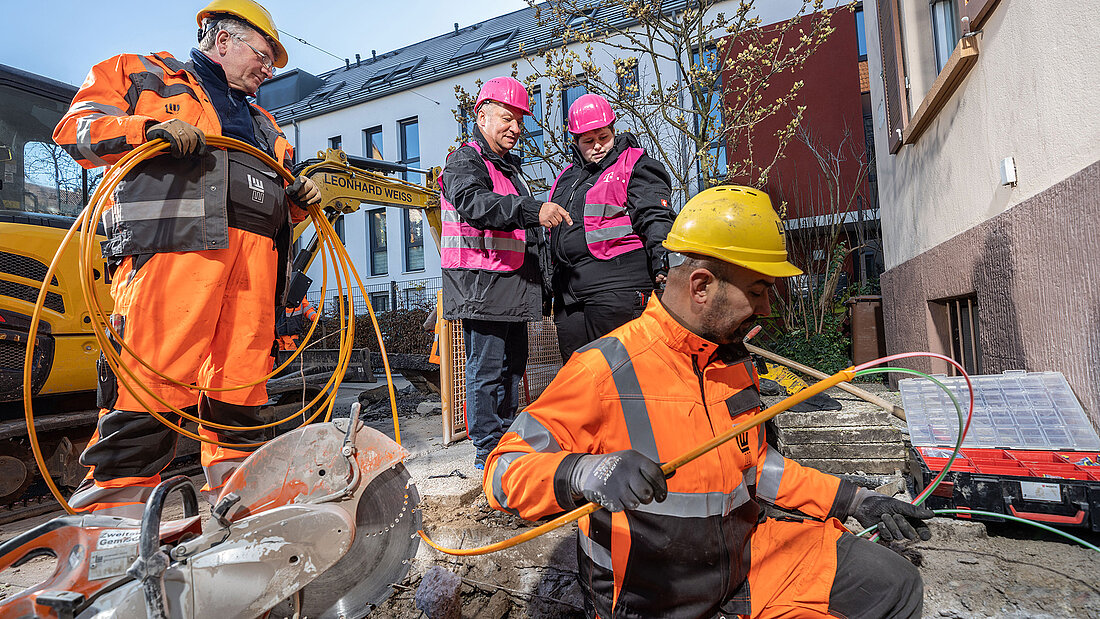
It means that large parts of Germany have yet to be reached by fiber optic lines. This market will continue to generate substantial revenues for years to come. Beyond that, even where a fiber optic line already runs beneath the asphalt, it often still needs to be extended from the street to the building and then distributed inside. Attractive business opportunities exist both in extending the network itself and in installing those final connections, spanning civil engineering, assembly work and material supply. The market for installation services alone is worth several billion euros in the years ahead.
“There is a multi-billion-euro market for installation services.”

Which regions need to ‘get up to speed’?
In the south and southwest of the country, expansion conditions are often more challenging: rural terrain and difficult soil conditions slow progress, and applications for government funding can sometimes delay the start of projects further. But this is precisely what makes providers of highly efficient, rapid rollout methods particularly attractive to German network operators. “Microtrenching” – the laying of cables at a depth of just 10 to 30 centimeters – is one such technique that is gaining significant traction.
What practical advice do you have for companies looking to enter the German market?
Construction service providers here need not only to work quickly; they have to deliver quality. This reflects a specific regulatory reality: in Germany, network operators are required to demonstrate to the state regulator that the construction firms they have commissioned have performed their work competently. As a result, network operators place a high premium on quality. It is also strongly advisable to employ German-speaking staff.
The expansion of Germany's fiber optic network is expected to finish by the end of the 2030s. What comes next?
While we at BREKO can only speak for the telecommunications industry, Germany faces a long pipeline of major infrastructure projects that will keep the sector busy for decades: expanding the electricity grid, rolling out charging infrastructure for electric vehicles and building district heating networks. The rail network, too, is in urgent need of refurbishment. So alongside the fiber optic rollout, there will be no shortage of work in Germany for companies specializing in civil engineering, assembly and planning.
5 States with the Most Potential
Share of premises in Germany that are near a fiber-optic network (and might be connected) – the five lowest-ranking German states by connectivity
| German regional state | Fiber rollout share in % |
|---|---|
| Rhineland-Palatinate | 56.8 |
| Bavaria | 53.3 |
| Thuringia | 52.1 |
| Baden-Württemberg | 45.4 |
| Saarland | 42.8 |
| German average | 62.0 |
Source: BREKO, 2026
Ready to seize the opportunity?

Paul Kaiser
GTAI’s industry expert